DataTools4Heart Docs
Comprehensive documentation for DataTools4Heart community software
View the Project on GitHub DataTools4Heart/documentation-hub
Virtual Assistant Documentation
The DT4H Virtual Assistant (VA) is a tool designed to support clinical researchers in cardiology and related fields. It enables researchers to interact in seven languages for the following tasks:
- Search for and explore studies, cohorts, and patient datasets
- Request and retrieve metadata before starting deeper exploration
- Ask targeted questions regarding study characteristics, patient cohorts, or hospital nodes
- Perform metadata requests in a federated way using a Secure Multi-Party Computation (SMPC) algorithm, ensuring data privacy and compliance with EU standards
Note: Metadata retrieval may take several minutes due to the distributed computation across nodes. It is recommended to request metadata at the beginning of a session.
All chat history with the VA is automatically stored. Researchers can browse previous conversations at any time, and they have the option to delete or export them.
Supported Languages
The VA supports interaction in 7 languages, selectable from the top-right menu:
- English
- Español (Spanish)
- Svenska (Swedish)
- Nederlands (Dutch)
- Italiano (Italian)
- Română (Romanian)
- Čeština (Czech)
Researchers can seamlessly switch between languages during interaction, ensuring accessibility across the European research community.
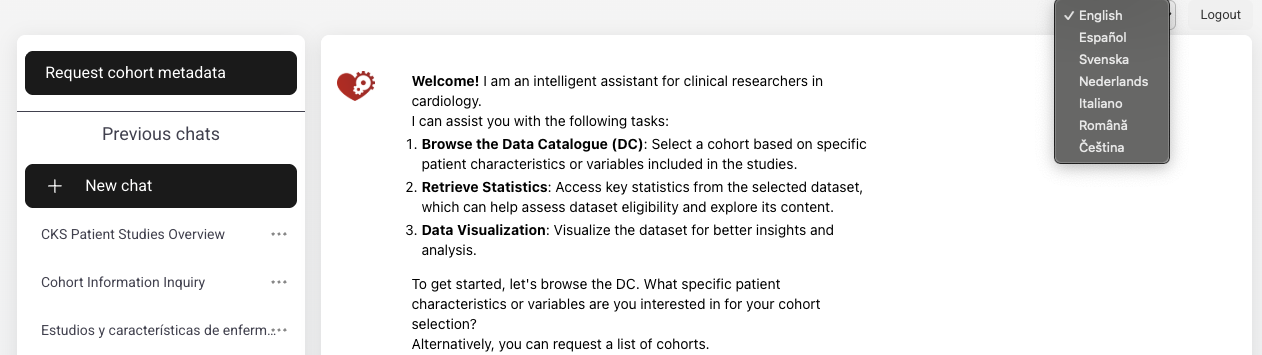
Language selection in the VA
Main Features
Study Search and Exploration
Researchers can use the VA to look for studies with specific patient characteristics, such as chronic kidney disease (CKD). Once a study of interest is identified, the VA also provides detailed information about the hospitals (nodes) that are included in the study. The results are retrieved from the Data Catalogue (DC), which displays the relevant datasets together with their associated attributes.
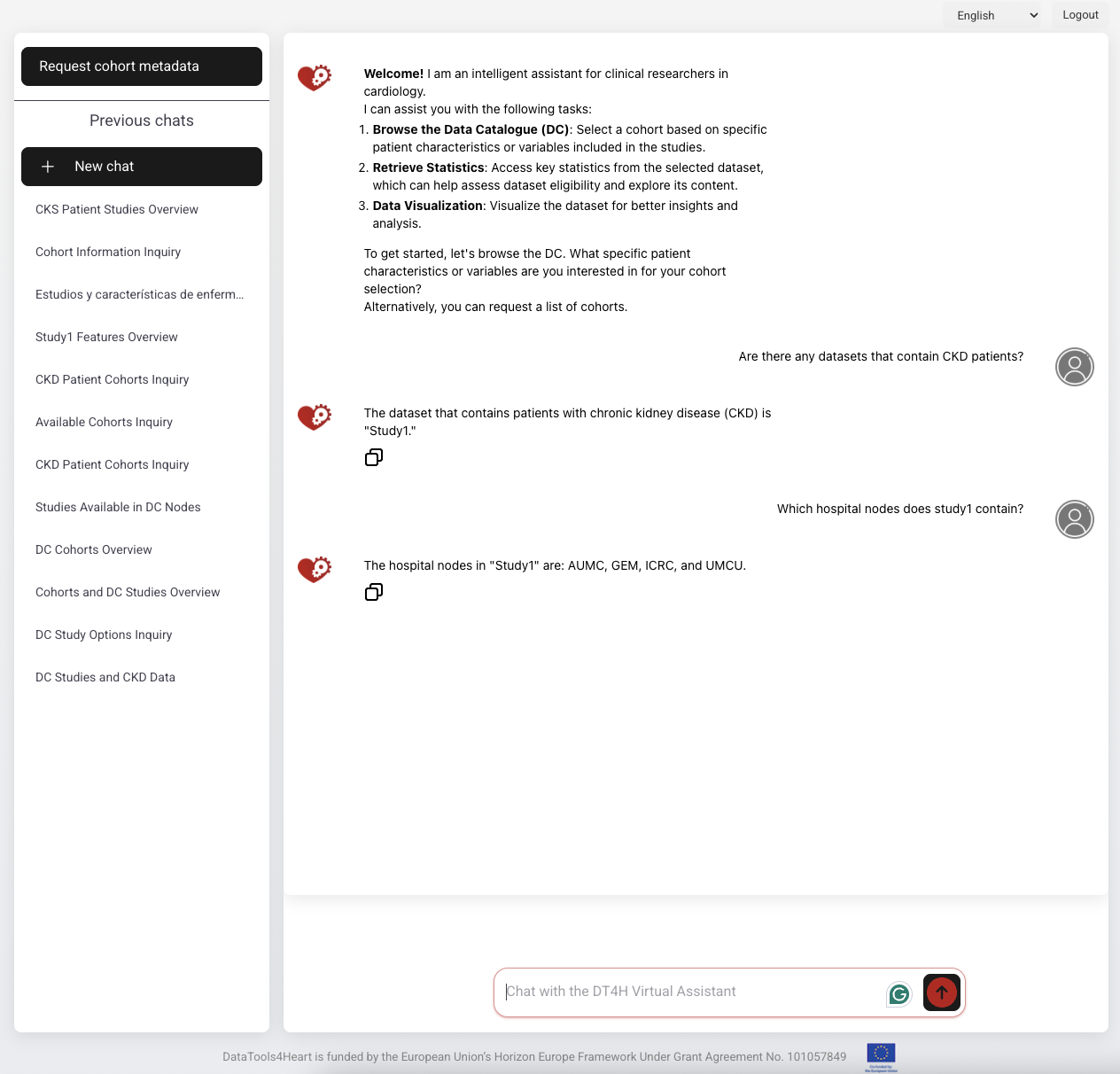
Example of study search in the VA
Metadata Request (Federated Step)
Before starting a conversation, researchers can request cohort metadata. This step runs a secure computation across all selected nodes using the SMPC algorithm.
Steps:
- Select Request cohort metadata from the left-hand menu and Create new request
- Choose the dataset name (e.g.,
study1) - Select the (hospital) nodes to include (e.g., GEM, AUMC)
- Click Create
Note: This step may take several minutes to complete. The status of the metadata request is shown (e.g., running, exited).
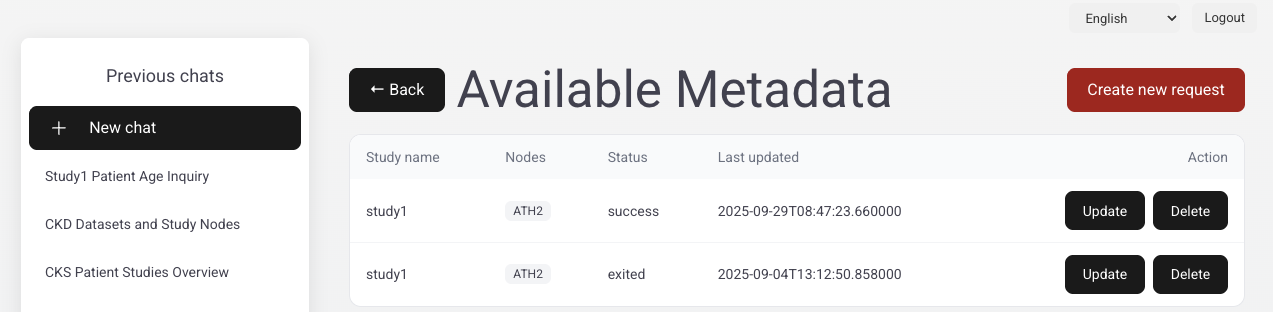
Overview of aggregated metadata requests

Creating a new metadata request for a specific study and nodes
Conversation with the VA
Once metadata is available, researchers can:
- Ask questions about patient characteristics (e.g., CKD, heart failure)
- Retrieve key statistics from the datasets
- Use data visualization tools for insights
The VA ensures results are based on privacy-preserving federated queries across distributed hospital nodes.